Start with your own must-have list
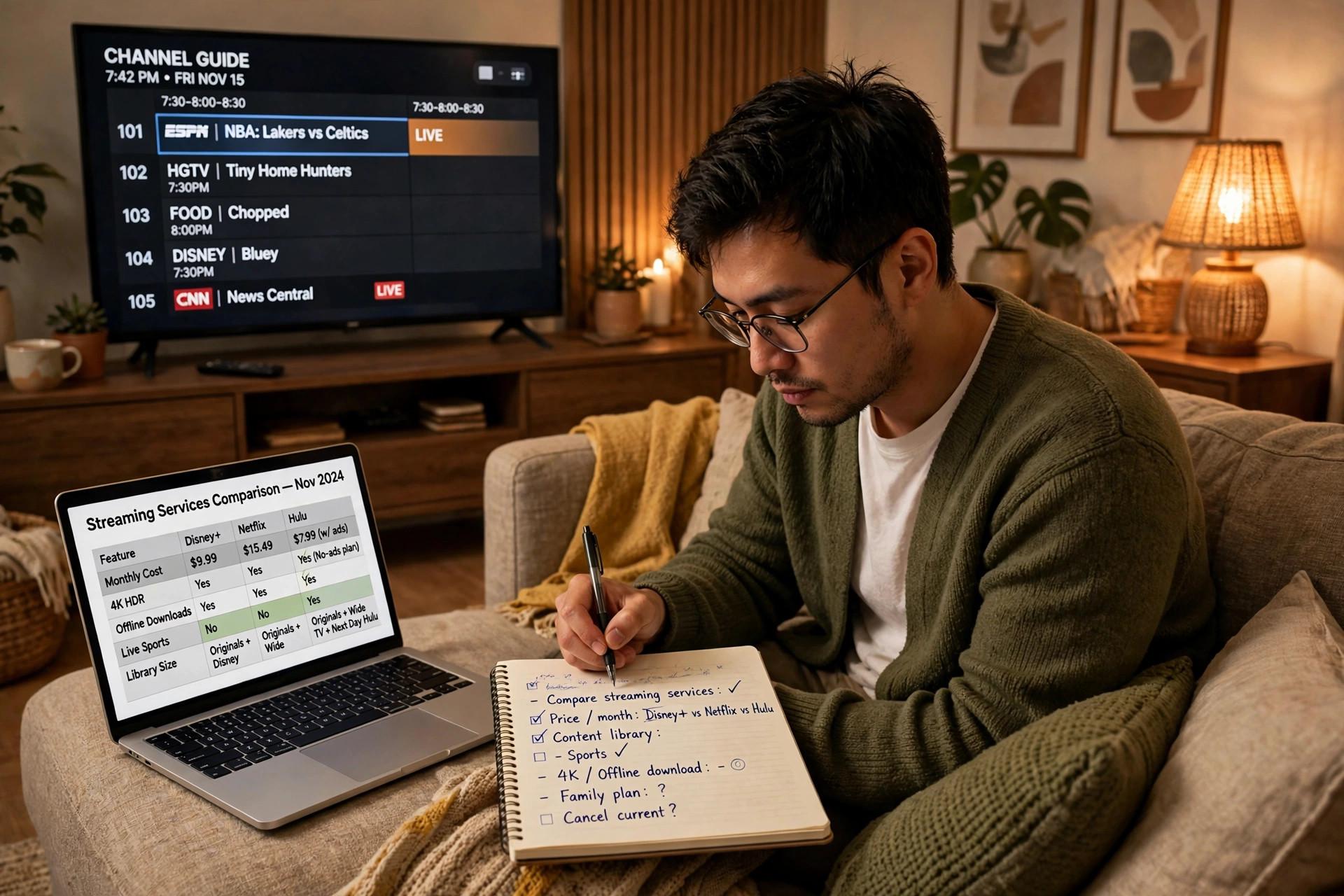
Before you compare providers, write down your own list: the five channels you watch every week, the sports you never miss, the devices you own, and the number of screens in the house. A household that watches ABC, NBC, CBS, FOX and ESPN needs those five above all else; a soccer fan needs NBC, USA Network and CBS; an NBA fan needs ESPN, TNT, ABC and NBA TV. The list turns a vague search into a test — open each channel during the trial and check it off. A provider that passes your list is a candidate; a provider that misses one channel on it is not, whatever the sales page claims.
Add the practical details to the list: your internet speed, your TV size, and your budget. A 4K TV needs a Premium plan with 4K streams; a 1080p bedroom TV is happy with Basic. A 25 Mbps connection can carry one 4K stream; a house with four screens needs 80 Mbps. A budget of $20 a month points to Premium at $19.99; a budget of $100 a year points to the yearly plan at $99.99. Write the list down before you start the trial, and judge every provider against it.
The 10-point checklist
Use this checklist for every provider you test, and score each point honestly during the free trial. One, channels open in under five seconds. Two, zero freezes during a full live game at peak time. Three, the EPG matches the real schedule at 7 PM, 8 PM and 9 PM. Four, the picture is real 4K at 60 fps on the channels that claim it. Five, support answers on WhatsApp within five minutes at 10 PM. Six, free remote installation is offered without a charge. Seven, the price is published clearly with no hidden fees. Eight, the refund policy gives 7 days, 30 days on yearly plans. Nine, the service works on every device you own. Ten, the trial needs no card details.
- Channels open in under five seconds at peak time.
- Zero freezes during a full live game on a Sunday evening.
- The EPG matches the real schedule at 7 PM, 8 PM and 9 PM.
- Real 4K at 60 fps on the channels that claim it.
- Support answers on WhatsApp within five minutes at 10 PM.
- Free remote installation is offered without a charge.
- The price is published clearly, with no hidden fees.
- The refund policy gives 7 days, 30 days on yearly plans.
- The service works on every device you own.
- The free trial needs no card details.
A provider that scores 10 out of 10 is worth the yearly plan. A provider that scores 8 or 9 is worth one month while you watch it longer. A provider that scores below 7 is not worth your money at any price — the points it fails are the evenings it will ruin. Start the free 24-hour trial and run the checklist on a Sunday evening, when every point matters most.
Test at the worst time, not the best
The single biggest mistake in choosing IPTV is testing at the wrong time. A trial on a Tuesday afternoon proves nothing, because the servers are quiet and every provider looks good. A trial on a Sunday evening, during an NFL game, proves everything, because the servers are under maximum load and only the reliable ones hold steady. Always run the trial at peak time: Sunday at 8 PM, a playoff game, a pay-per-view night. The service that passes the worst evening will pass every evening after it.
Test the picture the same way. A movie at noon looks good on any service; a live game at 8 PM shows the truth about bitrate, frame rate and server load. Watch the first half of a game on ESPN or FOX, count the freezes, and check the player stats for 4K and 60 fps. Our guide to testing any service has the full one-evening plan, and the stream quality guide explains the picture test.
Compare prices honestly
Once the trial passes, compare the price with the same honesty. Premium at $19.99 for one month, $49.99 for three months, $79.99 for six months and $99.99 for twelve months is a clear price with no hidden fees. Basic costs $14.99, $24.99, $39.99 and $59.99 for the same lengths. Multi-device yearly plans run $159.99, $224.99 and $269.99 for two, three and four devices. Compare the trial result with the price, not the price alone: a $19.99 service that passes every test is cheaper than a $9.99 service that freezes during the Super Bowl.
Watch for the pricing tricks that mark a bad provider. Prices hidden behind a chat message, prices that change every time you ask, a setup fee that appears at checkout, and a renewal price higher than the first month are all warnings. A reliable provider publishes its prices on the plans page and charges the same price every time. If the price is a secret, the service is a gamble.
Support is half the decision
A service with great servers and no support will fail you on the one night it matters, because every setup breaks eventually. Test support during the trial with a real question, at 10 PM, and time the reply. Under five minutes with a clear fix is excellent. A reply that asks the right follow-up questions — which device, which channel, what time — is even better, because it means a technician is diagnosing, not stalling. Our customer support guide explains what good support looks like, and the 24-hour support guide covers the night test.
Free remote installation is part of the decision too. A provider that sets up every device for you, free, in ten minutes, is a provider that wants you watching, not struggling. A provider that charges extra for installation, or sends you a video link instead of helping, is telling you what support will look like for the next twelve months. Test it during the trial and judge the people, not just the streams.
Read the refund policy before you pay
Read the refund policy before you pay from anyone — it takes two minutes and tells you whether the provider expects you to stay because the service is good or because leaving is hard. A fair policy gives 7 days to change your mind and 30 days on yearly plans, with refunds to the original payment method in 5 to 10 business days. Our refund policy is published in plain English for exactly that reason, and the trial plus the refund window give you 8 days of protection before you commit to a year.
Use the window. If the service freezes during the first week, or support goes quiet after payment, ask for the refund inside the window and switch. A provider that processes the refund quickly is honest even in defeat. A provider that fights it is showing you who they are, and the money you get back is the cheapest lesson in the market.
Red flags that mean walk away
Walk away from any provider that refuses a free trial, hides its prices, or only accepts gift cards or cryptocurrency. Walk away from support that only answers before payment and goes quiet after it. Walk away from a channel list that never changes and a guide that is always wrong. These are not small flaws; they are the signs of a service that will not be there when you need it. The trial exists to catch them early, while it still costs you nothing.
One more red flag: a provider that promises every channel in the world, including channels that do not exist, or claims a picture quality no internet connection can deliver. Honest providers list real channels — ABC, NBC, CBS, FOX, ESPN, HBO — and real quality — HD, 4K, 8K where the channel broadcasts it. If the sales page reads like a dream, the trial will show you the reality. Trust the trial, trust your checklist, and pay only when the service has earned it.
The decision: one month, then a year
The safest way to choose is in two steps. First, take the free 24-hour trial on a Sunday evening and run the 10-point checklist. If the service scores 9 or 10, buy one month of Premium at $19.99 and watch it for the full month — four Sundays, a playoff game if one falls in the month, and a few weeknights. If the month is clean, upgrade to the yearly plan at $99.99, which is less than one month of cable TV, and add the multi-device plan if the household needs it.
That two-step path costs $19.99 to test properly, and it is the cheapest insurance in television. A provider that earns the first month will earn the next eleven, and a provider that fails the first month has cost you $19.99 instead of $99.99. Start the free trial tonight, run the checklist on Sunday, and let the service earn your money — the best IPTV service USA viewers can choose is the one that proves itself before you pay.
After you subscribe, keep the checklist. Run it again after a month, and again after three months, because a service that was excellent on day one should still be excellent on day ninety — and a service that degrades over time is a service to leave before the yearly renewal. The checklist is not a one-time test; it is the habit that keeps your TV reliable all year, and the five minutes it takes are the cheapest insurance your household can buy.
Price is the last thing to compare, not the first. A cheap plan that freezes every Sunday costs more in frustration than a yearly Premium plan that simply works, and the difference between $59.99 Basic and $99.99 Premium is less than a dollar a week for 47,000 more channels, 4K, and every sport. Work through the tests in order: channels you actually watch, freezing at peak hours, guide accuracy, support at night, and picture quality on your TV. Write the results down for two providers side by side, and let the notes decide. The cheapest plan that passes every test is the right one, and the most expensive plan that fails the Sunday test is money wasted. Start with the free trial, run the checks at 8 PM, and buy the plan that earned it.